
The following words were preached by Fr Augustine in St Katherine’s, Butcher Row, London on the 1st Sunday of Lent 1984 and are transcribed from his handwritten notes, made in an old diary from 1968!
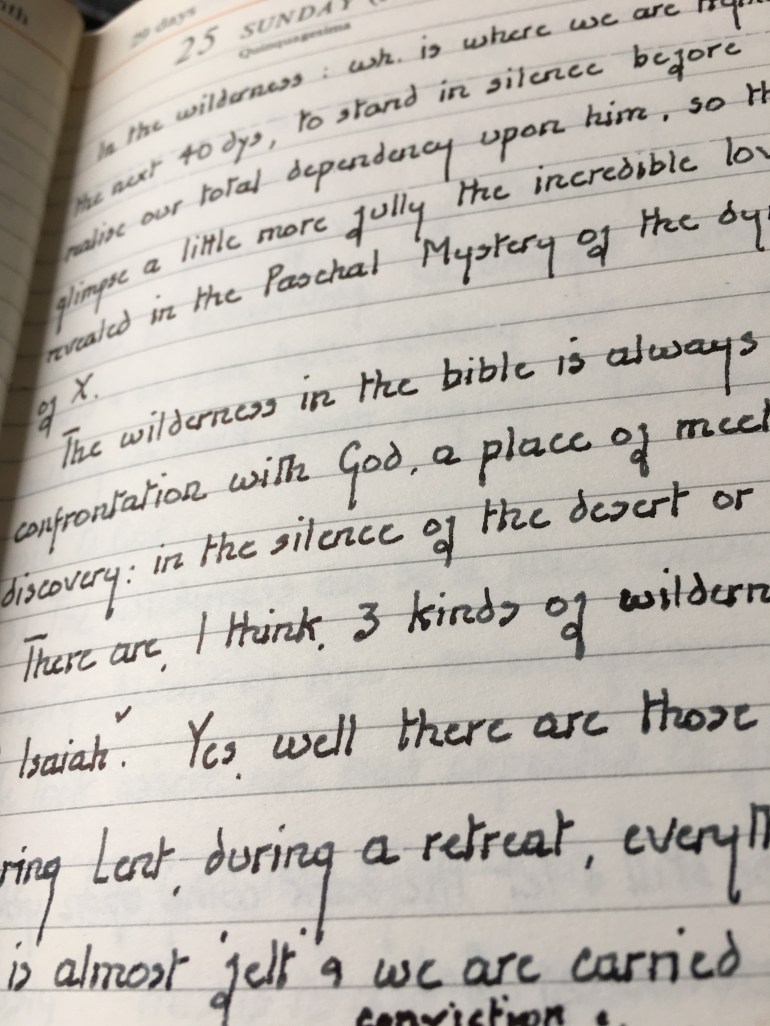
In the wilderness; which is where we are trying to be for the next 40 days, to stand in silence before God, to realise our total dependency upon Him, so that we may glimpse a little more fully the incredible love of God revealed int he Paschal Mystery of the dying and rising of Christ.
The wilderness in the bible is always a place of confrontation with God, a place of meeting, a place of discovery; int he silence of the desert or the silence of the mountain.
There are, I think, three kinds of wilderness, three meetings:
- In the beginning of Chapter 35 of the prophecies of Isaiah we read: “The wilderness and the solitary place shall be glad, the desert shall rejoice and blossom as the rose. It shall blossom abundantly and rejoice even with joy and singing and those who come to it shall see the glory of the Lord, the excellency of our God.” Yes, well, there are moments when, during Lent or during a retreat, everything becomes clear. God is almost ‘felt’ as we are carried along on a great surge of religious conviction. “It is good Lord for us to be here”, Peter said in the Transfiguration experience in the wilderness setting of the mountain.
- The wilderness of (today’s gospel reading) where we are confronted with evil, with a struggle; not a place of calm and tranquility at all. Having left behind all the various escape routes of our lives, which is what Lenten fasting is all about, we are brought face to face with ourselves and have to try to see everything from the point of view of Eternity. The experience can be, should be, devastating. We brought nothing into this world and we can take nothing out – so then what is holding us back from saying, “Lo I come to do your will O God”?
- The wilderness can be a place where everything seems empty, devoid of life – meaningless God is not. We look where we had expected to find him and he has gone. “My God, my God, why have your forsaken me?”. It is so easy piously, “I said to my should, be still and let the dark come upon you, which shall be the darkness of God”. this is to taste the despair of Job or Elijah. It is the darkness of the suffering servant of Isaiah. It is the desolation of Gethsemane and the dereliction of it. It is an authentic experience of God – ‘verily thou art a God that hides thyself’ – but it feels the opposite as all our cherished ideas of God are shattered.
Three wilderness then: reassurance, temptation, dereliction.
What has God got in store for us this Lent? Perhaps a taste of all three. We only have to make our selves available to know the answer.
 Msgr Augustine Hoey obl OSB
Thought provoking sermon a very wise and holy man.
LikeLiked by 1 person