
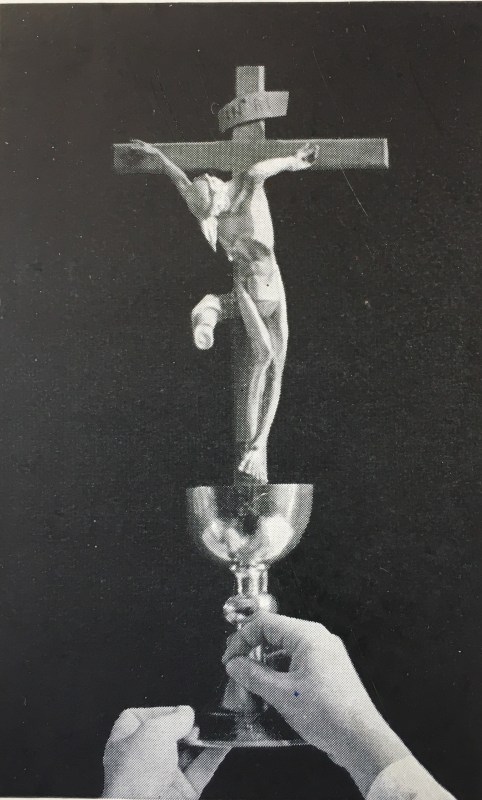
Taken from the papers of Fr Augustine, the following text formed an address given to a group of religious sisters. It’s teaching can also be applied to family life and indeed the Christian life in general.
Someone else had to take over and help Jesus carry His Cross. He was prepared to be helped. We religious like to think we are called to be Simon of Cyrene and hope that by our work and prayer we are helping to carry the cross of suffering humanity. Carrying the cross has powerfully struck the Christian imagination and is one of the dramatic and essential ideas of the Christian life.
If anyone wants to be a follower of mine, let him renounce himself and take up his cross everyday and follow me. [Luke 9.23]
This is part of the life through death theme of Christianity (dying, behold we live).
Pain is everywhere. Not all of it though, is a form of the Cross of Christ. Our bodies are heirs to a thousand natural shocks – arthritis, polio, cancer, MS, blindness, deafness, dumbness; a host of disabilities which are all part of the common lot of humanity. They are not the Cross of Christ. They deserve our sympathy and care, but the King of Glory does not die on them. Christ suffered for his ideas – not because of his physical disabilities.
It is essential to a Christian understanding of the Cross that Christ need not have ended his short and not altogether unhappy life there. He had to end it there because of the free decisions into which his freely chosen understanding of life led him. There have always been those whose decision for Christ has led them to intense suffering but there are also others for whom it has led to their lives being so much better organised and rescued them from so many pitfalls that it can only be described as a choice for joy and tranquility (perhaps us?). Even so we often wish we had made a better use of our choice, or, rather, God’s choice of us. There are frustrations and disappointments in everyday life. Some have to live with perpetual injustice. [In the original hand-written text Fr Augustine references South Africa, then in the grip of apartheid, and also comments, “we live within the chaos of the Church”]. In our praying mind we identify Christ carrying his Cross, with those who suffer under the burden of emotional, racial, political and economic pressures and because of this, each of these situations can be a place of the presence of God; we find Christ in every situation.
It is pious platitude to lift our eyes and think of every pin-prick as bearing the cross; to use Christ’s pain merely as a picture of our own! Our real experience of bearing the cross is the dying of the false and immature self that we have to undergo so that the real self, which God intends us to be, may come to life. It is a daily business and it hurts, but we remember always the joy that is set before us.
We only learn the freedom and love of this joy by the peaceful acceptance of the thousand lonely mistakes of egotism and ignorance which we make, the living with our own limitations and the acceptance of the consequences of all the same mistakes which others make. How important it is to live with and know our own limitations and those of others – not using them as an excuse for refusing to do the things we know we are capable of doing or being angry with our limitations and undertaking tasks which we know are beyond us.
Failure is part of life and we have to learn how to come to terms with it. Our Lord bore the Cross and died knowing that everyone – even the very close, thought of him as a failure. Perhaps he was tempted to think so of himself (“My God, my God! Why have You forsaken me”).
Some people have to bear such sufferings and tragedies that it is presumptuous of us to tell them how they are to be carried. We must not dramatise the anguish of others. They can only speak for themselves and usually such people are silent. Sometimes the faith and love of those who suffer and those who care for them is so great that the light shines through and the whole thinking of the world is turned completely upside down. What looks like limitation becomes divine glory, in the Johannine sense of the word ‘glory’. Our Lord, as he approaches his death says:
Now the hour has come for the Son of Man to be glorified. [John 12.23]
This turning of evil into good is only possible when it is accepted to be lived through with God and for God (as Our Lord accepted that) believing that He would be able to use it for His purpose in ways we shall probably only discover when we reach Heaven. In some cases others will be involved (the terminally ill and chronically sick) – the care of them involves a mutual acceptance and a sharing in dying. Jesus and Simon of Cyrene walk together! Acceptance, however, is not the same as resignation. To be resigned is a dead-end. It has no life in it. Acceptance is alert at every moment to the changing nuances of the situation even when the suffering and helplessness is getting worse and the darkness of the cross is closing in. To be accepting also means being adaptable, open to guidance, ready to change habitual attitudes and having the discernment to know they will not work this time.
It is a real cross to put up with ourselves. We do so want to be a spiritual success! This is always a particular temptation for those in the religious life, especially in the early stages. We find it doesn’t work. We get cross with ourselves for not being able to bear in peace and tranquility the thousand pin-pricks of living with the humanness of our sisters. We then grow either cynical or sanctimonious about the religious life, determined to show up the failures of our sisters by our own self-righteousness. It is part of the Christian life, let alone the religious life, to get used to being a rather unsatisfactory self. It is all never really going to come right in time! We have to learn that loving means sometimes making mistakes and having doubts, sometimes being overcome by evil and always being vulnerable. Don’t be one of those who refuses to be helped – to be more ‘Christian’ than Christ who had to accept the help of Simon the Cyrenean. It is not always more blessed to give than to receive.
 Msgr Augustine Hoey obl OSB