
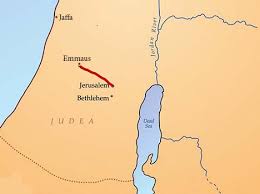
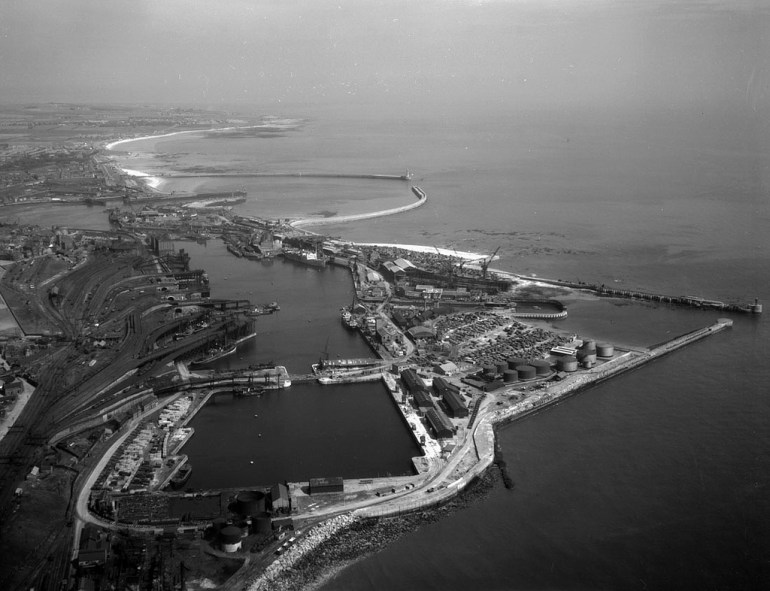
The following is a transcript of a hand written text by Fr Augustine, headed ‘Prayer in the City’ and is a reflection on the Emmaus project which, with the support of the Community of the Resurrection, he established first in Hulme, Manchester and later in the docklands of Hendon, Sunderland.


What kind of prayer? Presumably all committed Christians who live in cities practice prayer? I can only write of my own experience of living for eight years a life totally structured to prayer in the heart of the city; first in a block of flats in Manchester and then in a redundant Vicarage in the ship repairing yards and docks of Sunderland. The pattern of my prayer was such as can be found in any of our more traditional enclosed communities. The day and night were structured around six or seven Offices, there was time in the day for silent prayer, a daily Eucharist, and strict silence was kept throughout the day except for one hour’s communal recreation in the evening. Enclosure was not possible as shopping had to be done, exercise to be taken (there are no gardens in flats!) and on Sundays it seemed important to be at the Parish Mass so as to be seen as part of the on-gong life of the Church in that place. No other external activity was undertaken. There was the usual round of domestic chores and the house/flat was open to anyone who wanted to share the life and the silence or to seek counsel and absolution. At the beginning I was living alone but later was joined by first one and then two members of my own Community of the Resurrection. It is important, I think, when living in the midst of a teeming, working population, to be seen and known for what one is, so religious dress was maintained at all times. The diocesan bishop also recommended this. It was a great help in establishing relationships with the local people. The latter, though often inarticulate, had a deeper sense of what we were trying to be in their midst than some church-committed Christians! We were a visible symbol of their deepest unexpressed longings and they would often ask us to pray for them. So then our life was one of ‘monastic prayer’ in the city.
Is there any difference between prayer in the city and prayer offered elsewhere? Surely all prayer is ONE? Fundamentally ‘yes’ but the locus of praying can have a profound effect upon those doing it and can give both meaning and reassurance to those who feel God is calling them to serve Him and their neighbour in a life of prayer in the concrete jungle. God is everywhere. Yet we know by both experience and tradition that He seems to choose special places in which He emphasises the great Christian truths about Himself and where He strips off the shams and falsities to which so many fall victim and where He reveals the real needs of that world through which we are struggling to make our Christian pilgrimage. We can never fully understand or explain His choice of such places. The city is one.
The city is no new phenomenon – not even the large city. We are told in the book of Jonah that it took three days to walk across Nineveh! The Bible has a great deal to say about cities. The city is also important in the scheme of Christian redemption. Christ’s death and resurrection and the sending of the Holy Spirit all took place within the context of the city. Heaven, the goal of our Christian pilgrimage is likened to a city. We have here no abiding city: we are seeking one which is to come. It promises to be a society purged of the ‘darkness’ and self-centredness which disrupt and dismay its earthly counterpoint. Many people today think that social problems are a new aspect of city life. This is not so. They are part of the cities of all time and must have been particularly acute in societies based upon slavery.
The city, or rather the people who live in it give off their own ‘vibrations’ which are infectious and create a climate of ‘feeling’. If, as our Lord tells us, evil is ‘within’ the heart of man then the place where people gather together has a greater potential for evil, a sum totally greater than that in each individual heart. These who try to keep their faces turned towards God in the city, particularly those whose life style is structured entirely to prayer, find themselves in the front-line of the age-old struggle between light and darkness. They meet head-on all that militates against God in the city. ‘We wrestle not against flesh and blood but against… the spiritual hosts of wickedness in the heavenly places (Col.6.12). There is no sense of drama in such a struggle but only an interior participation in the meaninglessness, the helplessness, the deprivations, the injustices, the frustrations and the violence which haunt those who live in the western city of today. Monastic prayer in the city is to accept the suffering of living and wandering in a temple of false gods: gods as old as man, embodying cults of money, sex and power, to which so much adoration is given by the media, the politicians and some educationalists and social workers.
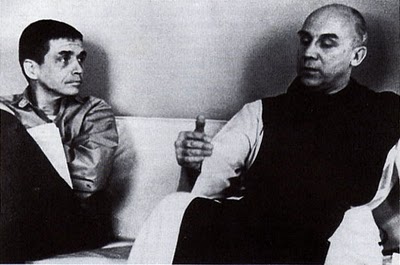
It was the well-known American Jesuit, Fr Daniel Berrigan, who said that the great need of the city of today which the monastics, both men and women, could best meet, was to establish centres of prayer in the midst of where the people lived.
The monk or nun is essentially someone who takes up a critical attitude to the contemporary world and its structures. Poverty, chastity and obedience are a protest against the world, the flesh and the Devil. The life of prayer is a most realistic identification and encounter with the forces within man which direct and shape society and life. Karl Barth put it well when he said, ‘to clasp the hands in prayer is the beginning of an uprising against the disorder of the world’. The spirituality of such a life is that of Gethsemane, with its interior anguish as the emptiness and the lack of authenticity in the life of modern man seek to possess those who offer themselves, at the call of God, to bring light to those who sit in the city’s shadow of death. It is a work of our liberation, because witnessing and suffering patiently is itself a spiritual power by which evil is overcome.
Don’t let us romanticise or dramatise this conflict. Prayer in the city is in the ‘desert tradition’ in so far as the wilderness is not only a place for silence and contemplation, but also in our Lord’s experience the scene of temptation and struggle with the evil forces which seek to deceive and destroy. Such prayer brings its own mortifications.
- It is an offering made in sheer naked faith prompted by love for our fellow citizens and its effect on them is usually ‘hid from our eyes’. To stand committed to prayer which appears to have no obvious results (except on us!) takes us deeper into darkness and fills us with a sense of helplessness and powerlessness. It is death indeed: the kind of death from which God can produce resurrection in His own way.
- The frustrating yoke of feeling we are doing nothing active when all around us the city’s social problems cry out for attention. There is so much more we could DO which the world and our fellow Christians would understand and applaud. Such service to our fellow men would bring us great satisfaction too!
- The realisations that a great deal of superficial nonsense is written about ‘identification’. We may live under the same physical conditions of housing as the under-privileged in one of the run down areas of the inner city, running risks of violence , robbery and vandalism, but the identification is only a superficial one. We are there by choice; our neighbour is not. We always have the security of knowing that we live out our lives and see our difficulties against the perspective of the wide sweep of eternal life. Our neighbour does not usually share the vision. Perhaps the problem is best stated in the story of the three nuns in Paris who went to live in one of the worst run down tenements of that city. They asked their neighbour in for a cup of coffee and in the course of conversation said, ‘now at last we feel one with you’. ‘Do you?’ she replied. ‘How can you possibly know what it is like to bring up four children under these conditions and cope with a husband who tends to get violent when he’s had too much to drink? I’m glad you are here, sisters, because in a way I can’t explain, I feel you are a support. But you can’t ever be one of us. You have come in from outside’. So if we establish a city house of prayer we have to learn what it means to be IN the city but not OF the city. This can be painful. Those of us who belong to a monastic family with its corporate ownership and sense of ‘belonging’ can never really identify with the insecurity and rootlessness which bedevils many citizens. The realisation of this cuts us down to size.
There are many ways the ‘religious life’ can find authentic ways of serving the inner city. Prayer is the primary one. Yet even monks and nuns, friars and religious brothers and sisters are harried and beguiled by ‘activism’. It would be more consistent with our vocation to be instead the leaven in the lump, working silently in prayer. For this the city needs us.
 Msgr Augustine Hoey obl OSB